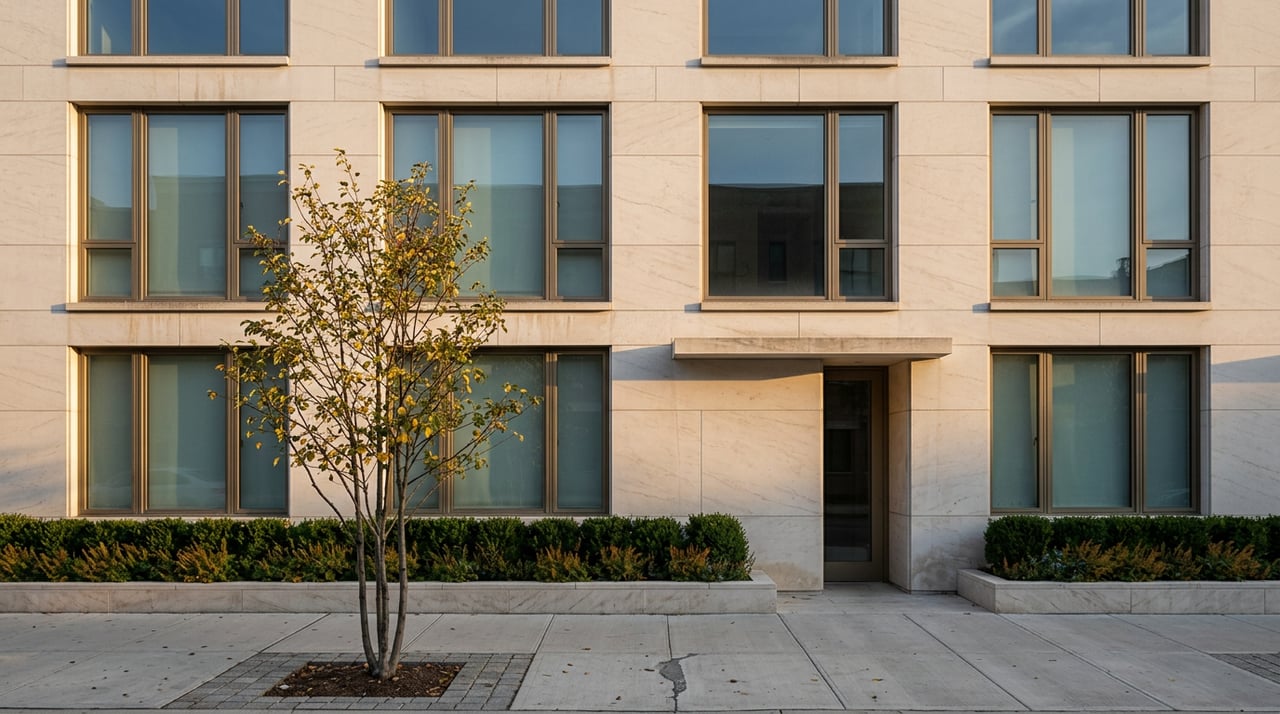
Walk into Lantern House on West 18th Street this month and a broker will quote you an average of $3,274 per square foot for what is currently on the market. Pull the building's last 60 closed sales and the number drops to $2,534. That is not a rounding difference. It is a $700-per-square-foot gap, in the same building, under the same High Line address, and it tells you more about how to shop Chelsea right now than any median price you will find on a portal.
The Building That Proves the Point
One High Line, the Bjarke Ingels-designed twin-tower condo at 500 West 18th Street, shows the same pattern from a different angle. As of this month, 15 units are listed there at an average asking price of $3,305 per square foot. That asking number sits well above what the building has actually delivered at the top of the market: in October 2025, a penthouse that had asked $52 million closed at $47 million, according to 6sqft's reporting on the sale. Sellers list at the aspirational number. Buyers, especially at the top of the range, have been negotiating it down.
This is not a story about a soft market. Chelsea's luxury corridor is still producing headline-grabbing closings. It is a story about what "High Line proximity" is actually worth, and the answer turns out to be more specific than most listing copy admits.
Two Neighborhoods Sharing One Name
Part of the confusion is that Chelsea is not one housing market. It is two, stitched together under a single neighborhood name.
West of Tenth Avenue, the building stock is almost entirely new construction: full-floor condos, starchitect authorship, High Line frontage. This is where you find One High Line, Thomas Heatherwick's Lantern House, and Zaha Hadid's curved residential building at 520 West 28th Street. As of August 2026, this corridor trades between $2,800 and $4,500-plus per square foot, with trophy penthouses clearing $20 million to $60 million.
East of Eighth Avenue, the stock tilts toward prewar co-ops and converted lofts, buildings like Walker Tower among the more established options. That side of the neighborhood trades at roughly half the per-square-foot pricing of the West Chelsea corridor, in the $1,400 to $2,200 range.
| West Chelsea | East Chelsea | |
|---|---|---|
| Price per square foot (Aug 2026) | $2,800 to $4,500+ | $1,400 to $2,200 |
| Typical building stock | New construction, starchitect condos | Prewar co-ops, loft conversions |
| Example buildings | One High Line, Lantern House, 520 West 28th | Walker Tower |
| Draws buyers with | High Line frontage, Hudson River views, full-service amenities | Established co-op stability, character, lower carrying costs |
Any single "Chelsea median" you see quoted on a national portal is an average of these two markets, which means it describes neither of them well.
What the Elevation Study Actually Found
Here is the detail that changes how a High Line-adjacent listing should be evaluated. Housing-value research on the park has found that homes closest to the High Line saw a 35.3 percent increase in value, but the largest share of that premium accrued specifically to units at the same elevation as the park itself, not simply to units within a certain number of blocks.
That distinction matters because "steps from the High Line" is doing a lot of work in Chelsea marketing right now, and it is not always the right work. A third-floor unit two blocks from the park that happens to sit at High Line grade, with an open sightline over the greenway, is capturing a different premium than a twentieth-floor unit directly across the street that looks down on the park as one element among many. The address is the same. The value driver is not.
For a buyer comparing two listings with similar asking prices per square foot, the question worth asking is not "how close is this to the High Line" but "what floor is this on relative to the park, and does the layout actually put a room against that view." A building can advertise High Line proximity on its facade and still price a unit that never really benefits from it.
Why the Neighborhood-Wide Median Is Nearly Useless
The bimodal split shows up clearly in the transaction data. In May 2026, 85 homes changed hands in Chelsea, and within that single month the median condo sale price was $2.9 million, up 59 percent year over year, while the median co-op sale was $838,000, up 47.1 percent year over year, according to PropertyShark's tracking of the neighborhood. Widen the lens to the full second quarter and the blended median across both property types was $1,725,000, up 51 percent year over year, a number that describes almost no actual transaction in the neighborhood, because almost nobody is buying the blended average of a West Chelsea condo and an East Chelsea co-op.
Zoom out further and the picture gets more textured, not less. Zillow's tracking shows the typical Chelsea home value at $1,413,933 as of July 2026, down 1.9 percent over the past year, even as West Chelsea's trophy tier keeps setting records. Both things are true at once: a citywide-facing measure of "Chelsea" shows softness, while the specific corridor along the High Line keeps producing record penthouse sales. That gap is the whole story of this neighborhood right now, and a single median price cannot hold both halves of it.
With sales counts that small in any given month, a handful of trophy West Chelsea closings can swing the blended median by hundreds of thousands of dollars in either direction. That is not a market becoming less predictable. It is a small sample doing what small samples do when you average two different markets together.
The School and the Superblock Reshaping the East Edge
Two forces are pulling more family demand toward the eastern and southern edges of West Chelsea specifically, which is worth understanding if you are weighing a purchase there against the East Chelsea co-op stock.
The first is Avenues: The World School, whose presence has become a meaningful driver of family relocation into West Chelsea, with buyers increasingly targeting the corridor for school proximity paired with new-construction layouts built for family life rather than pure amenity display.
The second is farther east: Related has partnered with NYCHA and Essence Development on a large-scale redevelopment of the Elliott-Chelsea and Fulton Houses, a project shaped by resident engagement that began in 2019 and is set to bring updated healthcare facilities, grocery stores, and community space to that stretch of the neighborhood. It is a slower-moving story than a new condo tower going up, but it is reshaping the eastern edge of Chelsea in ways that will matter to anyone deciding whether East Chelsea's value proposition holds up over the next several years.
What This Means If You're Actually Shopping Chelsea
If you're comparing listings in this neighborhood right now, a few things are worth checking before you anchor to a per-square-foot number:
- Ask which side of Tenth Avenue the building sits on, and whether the psf quote you were given reflects West Chelsea new construction or East Chelsea prewar stock. They are not comparable.
- For any listing marketed on High Line proximity, ask what floor the unit sits on relative to the park's elevation, and whether a room actually faces that sightline.
- Pull the building's recent closed sales, not just current asking prices. The gap between the two, as at Lantern House and One High Line this year, tells you where a seller has room to negotiate.
- If you're weighing East Chelsea for value, factor in that the psf gap versus West Chelsea is roughly two to one, which is a meaningful head start on carrying costs even before co-op maintenance is considered.
A Few Direct Questions
Is a High Line-adjacent condo always worth the premium over a similar unit a few blocks away? Not automatically. The value research points to elevation and sightline as the real drivers, so two units at similar distances from the park can carry very different real premiums depending on floor and exposure.
Why does Chelsea's median price look so different depending on the source? Because Chelsea blends two markets, West Chelsea new-construction condos and East Chelsea prewar co-ops, into one neighborhood name. A blended median with a small quarterly sample size can shift heavily based on which few high-end deals closed.
Is East Chelsea a compromise or a genuine value play? It depends on what you're optimizing for. East Chelsea trades at roughly half the psf of the High Line corridor and offers established co-op stock and lower carrying costs, while West Chelsea offers new construction, family-oriented layouts near Avenues, and the specific view premium the elevation research describes.
Chelsea rewards buyers who ask which market they're actually in before they ask what the price per square foot is. If you're comparing a West Chelsea tower against an East Chelsea co-op, or trying to figure out whether a specific unit's High Line marketing matches its actual sightline, that is exactly the kind of building-by-building read our team does for clients across Manhattan every week. DTNYC Team can walk you through the current asking-versus-closed gap on any Chelsea building you're considering. Request a VIP Market Valuation to start.
