In 1974, a puppeteer named Ralph Lee walked a few hundred friends and neighbors out of Westbeth, the artists' housing complex on Bethune Street, and led them toward Washington Square Park in homemade masks and paper-mâché costumes. About 200 people showed up. By the next year, that number had grown to 1,500, and the informal walk had already won an Obie Award for the puppetry Lee brought with it.
Fifty-two Halloweens later, the same event draws an estimated 50,000 to 80,000 costumed marchers and as many as two million spectators. It is now the only major nighttime parade in the country, and it still starts less than a mile from where Lee first stepped out his door. But it doesn't walk his block anymore, or Bank Street, or Perry, or Charles. It hasn't touched those winding residential streets since the early 1980s, when the crowds got too large for them to hold.
That's the part most visitors miss and most residents already know without saying it out loud: the parade that West Village history claims as its own runs along the neighborhood's eastern edge, not through its center.
The Blocks It Left Behind
For its first decade, the parade wound through the Village's side streets on its way to Washington Square. According to Village Preservation, Westbeth remained the starting point until the 1980s, when the crowds outgrew what those narrow, curving blocks could physically contain. Organizers moved the route onto Sixth Avenue, a straight, wide corridor that could actually process the volume. That decision ended the parade's direct link to Washington Square Park and put it on the boundary line that separates the brownstone core of the West Village from the rest of Greenwich Village.
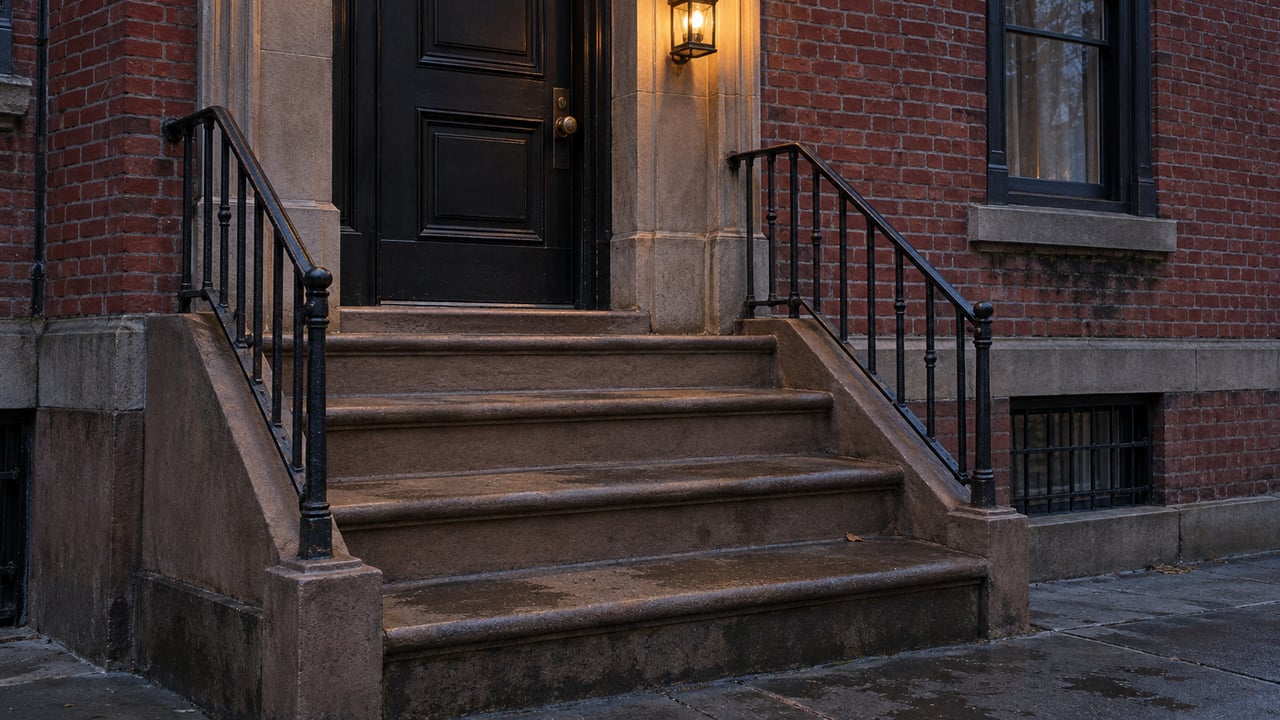
That boundary is where it has stayed. If you live west of Sixth Avenue, on the blocks that draw people to the neighborhood in the first place, the parade doesn't come to you. It comes near you. You hear it. You might walk two minutes east and stand at the edge of it. But your stoop, your block, the actual residential fabric of the West Village, is not on the route and hasn't been for more than forty years.
What Actually Comes Through This Year
The 53rd annual parade steps off Saturday, October 31, 2026, at 7 p.m., with this year's theme announced as "Body & Soul." Grand Marshal duties go to Joey Arias, the downtown cabaret and drag performer currently appearing nightly at HERE Theater in his own show, a fitting choice for a parade whose roots run through the same queer, downtown performance scene that shaped Village nightlife long before Sixth Avenue became its route.
Leading the march this year is a new commissioned puppet called Firehorse!, designed by MacArthur "Genius" grant recipient and puppeteer Basil Twist, choreographed by performance artist Julie Atlas Muz, and produced by Barbara Busackino of Tandem Otter Productions. It joins more than 50 bands, dancers, and giant puppets built by the official puppetmakers, Processional Arts Workshop, in what organizers describe as a night built around the connection between the physical body and the spirit people carry inside it.
The route itself runs from the Canal Street and Sixth Avenue lineup north to 15th Street. Costumed marchers can join the lineup between 6:30 and 9 p.m., entering only from the east and south on Sullivan, East Broome, or Canal Street. Spectators can watch from either side of Sixth Avenue between King Street and 15th Street, with the stretch from Bleecker to 14th consistently the most crowded section of the night. If you want to see the parade without fighting for sidewalk space, the blocks nearer King Street or nearer 15th tend to thin out earlier and later in the evening, since marchers are released in waves and the crowd density shifts as the night goes on.
The Building That Still Marches
There's one piece of the West Village that does travel with the parade every year, even though the parade no longer travels through the neighborhood itself. Since 1999, an animatronic spider designed and animated by Basil Twist has scaled the clock tower of the Jefferson Market Library, the old courthouse-turned-branch library that sits directly on Sixth Avenue at 10th Street, right on the parade's own route. The spider has been part of the procession since 1977 in earlier forms, but Twist's version is the one still climbing that tower today, on the same night he's debuting Firehorse! a few blocks south.
It's a small detail, but it says something the rest of the route doesn't: the one piece of West Village architecture written into the parade every year isn't a stand-in or a float. It's the actual building. Residents pass it walking to the subway or the farmers market on any ordinary Tuesday. On Halloween, it becomes the backdrop for a fifty-foot spider, and then goes back to being a library.
If You Live Here, Here's the Actual Night
The practical experience of Halloween in the West Village depends almost entirely on which side of Sixth Avenue you're on and how close to the Bleecker-to-14th corridor you happen to live or want to eat that night.
A few things worth knowing before October 31:
- Sixth Avenue closes to vehicle traffic for the parade window, and in past years southbound C and E trains have bypassed the Spring Street station entirely from roughly 5 to 10 p.m. while the northbound side operates exit-only, with the West 4th Street station shifting entrances to exit-only depending on crowd volume. The L train has historically kept its normal schedule, making it one of the more reliable ways to cross the area that night. Final 2026 service changes are typically confirmed by the MTA in the days just before the parade.
- The city's Trick-or-Streets program, which runs as a two-week series of car-free blocks leading into Halloween, has in past years included a Sixth Avenue closure from 16th Street down to Spring and a car-free stretch of LaGuardia Place. Locations shift slightly each year, so the confirmed 2026 map is worth checking closer to the date at nyc.gov/trickorstreets.
- For a sit-down dinner before the crowds thicken on Sixth Avenue, Rosemary's, the Italian restaurant with its own rooftop farm, along with Boucherie and Market Table, are the kind of reservations locals make ahead of Halloween weekend rather than the night of.
- After the parade winds down around 11 p.m., the crowd's energy doesn't stay in the neighborhood. The official afterparty, the Vampire Ball, relocates entirely to Industry City in Brooklyn, with doors opening at 9 p.m. and music running past 5 a.m.
If you're trying to get somewhere below 14th Street that night and don't want any part of the parade, the honest answer is to plan your crossing early or late, since the corridor is effectively closed to casual foot traffic from about 6 p.m. until well past 10.
The Second Act
The disruption doesn't end when the parade does. The TCS New York City Marathon runs the very next morning, Sunday, November 1, 2026, closing streets and straining subway service across all five boroughs before finishing in Central Park. The marathon course itself doesn't run through the West Village, but the citywide scale of it means subway rerouting, rideshare delays, and crowd density extend well past Sixth Avenue for a second consecutive day. Anyone planning a normal Sunday morning errand that weekend is better off checking service alerts before assuming the disruption ended with Saturday night.
Taken together, the parade and the marathon turn the last weekend of October into a two-day stretch where the neighborhood's edges do most of the work and its residential blocks mostly watch from a short distance. That's not a complaint about the parade. It's just the actual shape of the night, the one that doesn't match the version where the whole West Village shuts down for Halloween. The version where a fifty-foot spider climbs a library clock tower while the block behind it stays quiet enough to walk a dog.
If you're weighing what a night like this says about buying or selling on these blocks, that's a conversation worth having before the market moves without you. DTNYC Team can walk you through what it actually means to own property this close to Sixth Avenue, parade season and all.
